
APIs and service architecture
Model product workflows and business rules through clear interfaces. Service boundaries, data ownership and failure behavior should be understandable to the people who will operate and extend the system.
02Backend & cloud
Build APIs, integrations and cloud infrastructure around the workload your product actually needs, with maintainability and operational reliability designed in from the start.
Model product workflows and business rules through clear interfaces. Service boundaries, data ownership and failure behavior should be understandable to the people who will operate and extend the system.
Choose deployment and infrastructure patterns that fit current demand while leaving a practical path for growth. Environments, release processes and operational responsibilities are considered alongside application development.
Plan authentication, authorization, logging, monitoring, backup and recovery according to the product's risks and availability needs. Reliability is part of the delivery definition, not a post-launch add-on.
Connect payment, CRM, ERP and other services through validated interfaces, controlled retries and visible remediation paths. Integration contracts should make changes and failures easier to diagnose.
For established platforms, a phased approach can reduce migration risk and preserve business continuity. We assess dependencies and bottlenecks before choosing between targeted improvements and broader replacement.
ProofRelated work

A payment and transaction platform rebuilt for real-time processing, greater reliability and growing demand.
View case study
Architecture and infrastructure improvements prepared an existing MVP for an expanding user base.
View case study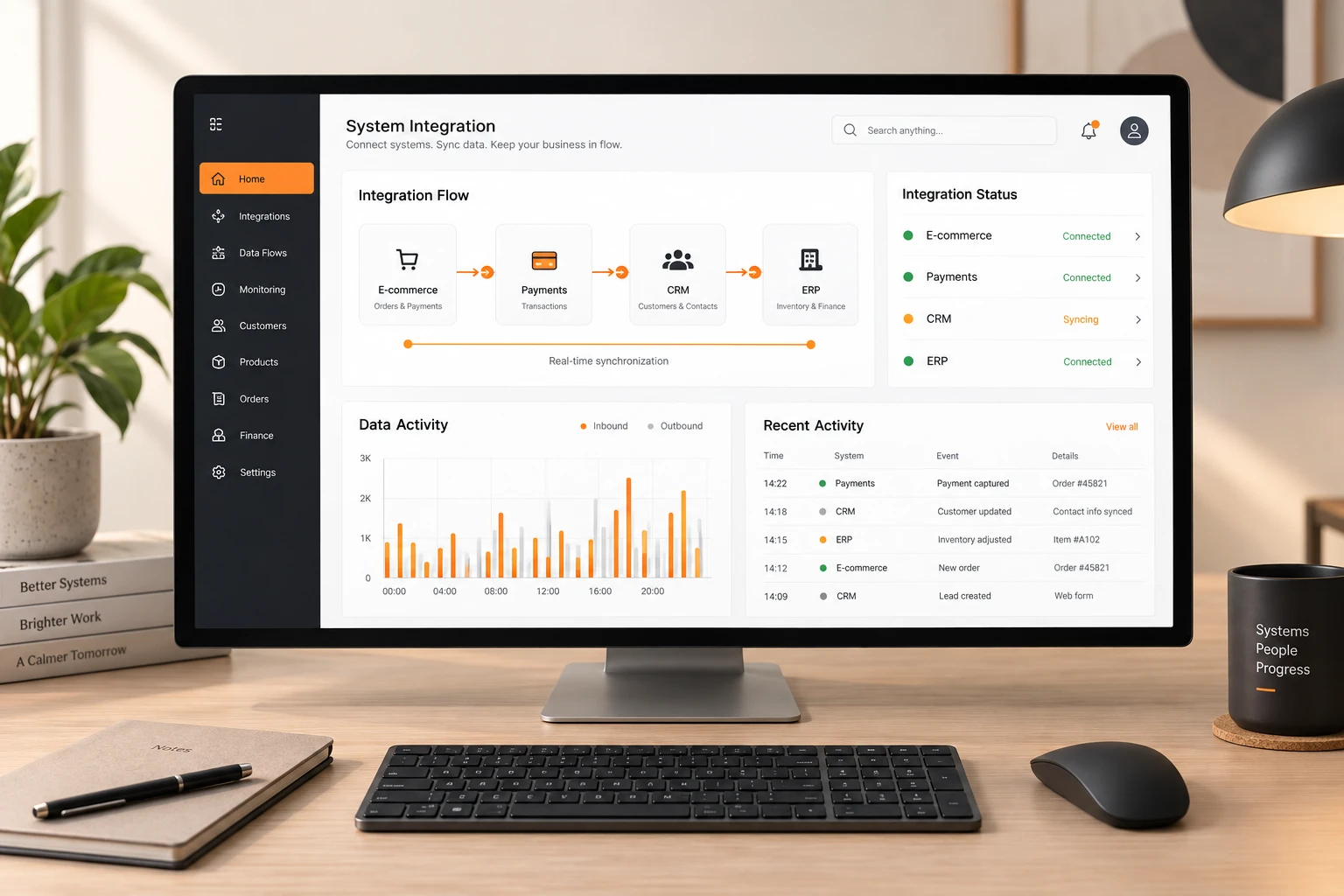
Payment gateways, CRM/ERP systems and internal tools were connected to synchronize data and streamline work.
View case studyFAQBefore we begin
Not necessarily. The decision should follow an assessment of current constraints, operational risk and the cost of change. A phased modernization can be more appropriate than a full rewrite.
Integration work can cover authentication, validation, data mapping, retries and failure handling. Feasibility and scope depend on the external system, its API and the workflow that needs to be supported.
Reliability planning considers the workload, important failure scenarios, monitoring, backups, recovery expectations and operational ownership. The appropriate controls vary with product risk and availability needs.
We review the current architecture, expected workload, integrations, deployment environment and main operational risks before proposing scope, milestones and an engagement model.
Share your current architecture, expected workload, integrations, reliability concerns and deployment environment. For an existing platform, include the main bottlenecks you want to remove.